by juritrustlaw | Mar 15, 2024 |

Fig.1
Just a few days before the world paid tribute to the resilience, industry and resourcefulness of women, members of a non-state armed group (NSAG) allegedly abducted an unverified number of women, girls and boys – IDPs from the ISS, Zulum, Kaigama, and Arabic IDP camps who were out in the bush in search of firewood. Some days later – March 7 to be precise 7th of March, 2024, bandits attacked the Kuriga community in Chikun Local Government Area of Kaduna State and kidnapped about 286 students including some teachers at the LEA Primary School Kuriga. The bandits are reportedly demanding one billion naira as ransom for the victims.
An unhealthy Spike
From 2011 to 2023, Nigeria experienced a dramatic increase in kidnapping incidents, with various reports and databases documenting the alarming trend. The Nigeria Security Tracker (NST) recorded about 19,800 incidents of kidnapping across the country within the past decade . While The Global Terrorism Database (GTD) identified Nigeria as the country with the highest number of reported kidnappings globally in 2019, underscoring the severity of the situation. Topping the list of most kidnapped persons are women, children, and internally displaced persons (IDPs), who are particularly vulnerable to kidnapping due to their perceived lack of protection and resources. Women and children, often targeted for ransom, sexual exploitation, forced marriage, and recruitment into armed groups, while IDPs face additional challenges stemming from their displacement and precarious living conditions.
Children, in particular girls, have been subjected to mass abductions from schools, such as the infamous incidents in Chibok and Dapchi, the recent kidnapping of over 280 school children in Kuriga town in Kaduna State and another 15 children in Gidan Bakuso in Sokoto State all between the ages of eight and fourteen. While some of the abducted children from the Chibok and Dapchi incidences of 2014 have been rescued or released, many including the recent victims of Kuriga and Gidan Bakuso remain missing, enduring unimaginable suffering at the hands of their captors while the search for them by the Nigerian government continues. Women are abducted for ransom or as part of broader criminal activities, including human trafficking, baby making machines and forced labour. The psychological and emotional toll on survivors of kidnapping, especially women and children, is profound and long-lasting, with many struggling to reintegrate into society even after their release.
Internally Displaced Persons
Targeting IDPs for kidnap and violations adds an ironic twist to official assurances on the security situation in Nigeria and the state of government’s preparedness to tackle kidnapping for ransom. Displaced by insurgency, tribal and inter-tribal conflicts, violence, and natural disasters, IDPs make up the most vulnerable populations in Nigeria.
The recent abductions of women and girls in three IDP camps in Borno State Nigeria highlights the vulnerability and lack of protection faced by these vulnerable groups, shedding light on the dire situation internally displaced persons, most especially women and children in Northern Nigeria are subjected to and the critical need to address their rights.
It is worth noting that these abductions not only underscores the vulnerability of internally displaced women to various forms of violence, including sexual assault, death, abduction and exploitation but also undermines the efforts of government and human rights organizations in securing the rights of internally displaced women and children.
Secondly, the incident exposes the failure of authorities to adequately protect and support internally displaced populations, particularly women and girls. Despite numerous reports of insecurity and threats within IDP camps, there appears to be a lack of effective measures to prevent such abductions and to ensure the safety of residents.
While the issue regarding the abductions of women from IDP camps remain a security concern, it is further intriguing to note that some of these women have been reported to have willingly returned to the bushes rather than remain at the camps. According to Governor Babagana Zulum of Borno State in a Statement on the 8th of March 2024, over 500 women living in IDP camps had demonstrated their interest in leaving the camp. Were these latest victims really in search of firewood or wandering away from abandonment?
Relevant Laws and Frameworks on The Rights of Internally Displaced Persons
In Nigeria, the rights of internally displaced persons (IDPs), especially women and children, are protected by various international and domestic laws, as well as policies and guidelines established by the government. Below are some of the key legal instruments and frameworks relevant to the rights of IDPs in Nigeria:
Nigerian Constitution: The Constitution of the Federal Republic of Nigeria 1999 (as amended) under Chapter IV guarantees the fundamental rights of all citizens, including IDPs. These rights include the right to life (Section 33) , dignity of the human person (Section 34), and freedom from discrimination (Section 42), among others.
Guiding Principles on Internal Displacement: Nigeria, as a member of the United Nations, is bound by the Guiding Principles on Internal Displacement, which provides a comprehensive framework for the protection and assistance of IDPs. These principles emphasizes on the rights of IDPs to protection, non-discrimination, access to humanitarian assistance, and durable solutions to displacement.
National Policy on Internally Displaced Persons: In 2012, Nigeria adopted the National Policy on Internally Displaced Persons to provide a framework for addressing the needs and rights of IDPs. The policy emphasizes on the protection of vulnerable groups, including women and children, and outlines measures for their assistance and support.
Humanitarian Assistance Framework: Nigeria has established a framework for coordinating humanitarian assistance to IDPs, which includes guidelines for the protection of vulnerable groups, such as women and children. This framework outlines the roles and responsibilities of government agencies, humanitarian organizations, and other stakeholders in providing assistance and support to IDPs.

Fig.2
Rights of Internally Displaced Persons
Regardless of how wide the legislation and laws for the protection of the rights of Internally Displaced persons are, there are certain fundamental rights which encompasses a broad spectrum of rights, these are;
- Right to Safety and Security:
-
- The United Nations Guiding Principles on Internal Displacement (UNGP) outlines the right of IDPs to protection and security during displacement. It emphasizes the responsibility of the government to ensure the safety of all displaced persons, including women and children.
- The Nigerian Constitution, particularly Chapter IV, Section 33, guarantees the right to life and security of all citizens, including IDPs.
- Right to Non-Discrimination:
-
- The UNGP prohibits discrimination against IDPs on the basis of gender, age, ethnicity, or any other grounds. It emphasizes the need for equal treatment and non-discrimination in the provision of assistance and protection.
- The Nigerian Constitution, specifically Chapter IV, Section 42, prohibits discrimination on the basis of sex, religion, ethnic group, or social origin. This provision applies to all citizens, including IDPs.
- Right to Access to Basic Services:
-
- The UNGP recognizes the right of IDPs to access basic services such as healthcare, education, and shelter. It calls for the provision of essential services to meet the needs of displaced persons.
- The National Policy on Internally Displaced Persons in Nigeria provides a framework for the provision of basic services to IDPs, including women and children.
- Right to Freedom from Violence and Exploitation:
-
- The Convention on the Rights of the Child (CRC) and the Convention on the Elimination of All Forms of Discrimination Against Women (CEDAW) both emphasize the right of children and women to be protected from violence, exploitation, and abuse.
- The Violence Against Persons (Prohibition) Act 2015 in Nigeria criminalizes various forms of violence, including domestic violence, sexual violence, and harmful traditional practices. This law provides protection for women and children, including those who are internally displaced.
- Right to Dignity and Respect:
-
- The UNGP recognizes the right of IDPs to be treated with dignity and respect, regardless of their displacement status. It emphasizes the importance of upholding the human rights and dignity of all displaced persons.
- The National Policy on Internally Displaced Persons in Nigeria emphasizes the need to respect the rights and dignity of IDPs, including women and children, in all aspects of their displacement.
Recommendation and Conclusion
In light of these issues, it is imperative for the Nigerian government, as well as international organizations and civil society groups, to take immediate action to protect the rights of internally displaced women and children in Northern Nigeria, through the implementing of adequate security measures within IDP camps, providing psychosocial support and assistance to survivors of violence, and addressing the root causes of displacement and conflict in the region.
We also need to revamp the security approach to take account of convergence between criminals and the present day terror gangs. The financing of terror groups or Non state armed groups or bandits through direct or laundered proceeds of such crimes like kidnapping, trafficking, cattle rustling drugs and counterfeiting signifies the need for enforcement and security agencies to adopt integrated or collaborative investigation instead of working in silos and in segmented patchworks.
Finally, efforts should be made to empower internally displaced women by ensuring their meaningful participation in decision-making processes and by addressing the structural inequalities that contribute to their marginalization. This may involve providing access to education and vocational training, promoting economic opportunities, and challenging harmful gender norms and stereotypes within the camps.
NOTE: The section on legal Briefs is a forum for frank and open scholarly notes by research staff and guest contributors. Views expressed in these notes are personal to the authors and are not to be attributed to the Centre.
DO YOU WANT TO SHARE YOUR VIEWS ON OUR BLOG?
JURITRUST Centre for Socio Legal Research and Documentation invites submission of short articles from VOLUNTEER CONTRIBUTORS who are interested in sharing their perspectives on salient issues in the administration and development of the Nigerian Criminal Justice System, comparative systems and related issues. CLICK HERE find out how to send us your articles. Thank you

by juritrustlaw | Feb 16, 2024 |
By Collins .I. Georgewill Esq, with assistance of Lydia Abbey and Ifeanyi Ewuziem Esq
Introduction
On the 23rd of January 2019, former President of Nigeria, Muhammadu Buhari signed into law the Discrimination Against Persons with Disabilities (Prohibition) Act, 2018 (the Act) following nearly a decade of persistent advocacy by human rights activists and organisations. The Act provides for the full integration of persons with disabilities into society and establishes the National Commission for Persons with Disabilities. It also vests the Commission with the responsibilities for the education, health care, social, economic and civil rights of persons living with disabilities. On the strength of the foregoing, it is axiomatic that a new legal framework for human rights protection was birthed the day this legislation was enacted. Little wonder, it has been said that the rights of persons with disabilities are human rights.
Rights of Persons with Disabilities as Human Rights
Who is a person with disabilities?
For conceptual purposes, this question is necessary. The Act in section 57 provides that the phrase ‘person with disabilities’ means: (a) a person who has received a temporary or permanent Certificate of Disability to have a condition which is expected to continue permanently, or for a considerable length of time which can reasonably be expected to limit the person’s functional ability substantially, but not limited to seeing, hearing, thinking, ambulating, climbing, descending, lifting, grasping, rising, and includes any related function or any limitation due to weakness or significantly decreased endurance so that he cannot perform his everyday routine, living and working without significantly increased hardship and vulnerability to everyday obstacles and hazards; and (b) a person with long term physical, mental, intellectual or sensory impairment which in interaction with various barriers may hinder their full and effective participation in society on equal basis with others.
Now that the meaning of a person with disabilities has been put in context, the next operative question is whether the rights of these persons qualify as human rights? Much will depend on the meaning of human rights. The definition put forward by Professor Louis Henkin[1] is apposite to our purpose. The erudite professor defined human rights as those liberties, immunities and benefits which by accepted contemporary values, all human beings should be able to claim as of right of the society in which they live. Thus, if human rights are named because of their universal application to all and not just some; do the rights of persons with disabilities qualify as human rights?
This poser has a relatively long-standing existence as it caught the attention of social scientists and policymakers at the international scene during several high-level discussions culminating in the United Nations Convention on the Rights of Persons with Disabilities (UNCRPD).
Responding to propriety of classifying rights of persons with disabilities under the UNCRPD as human rights, Caroline Harnake and Sigrid Graumann opined that: human rights obviously also applies to people with disabilities. The justification of human rights is often based on human dignity…Yet the conclusion that human rights necessarily also apply to people with disabilities seems to question the necessity of a special human rights convention for disabled people. If everyone including disabled persons is protected by other human rights instruments, why then is the convention needed. The reason is that some humans seem to be insufficiently protected by the general human rights legislation. This holds not only for disabled people, but also for children or women. Therefore, they require tailoring of the general rights regime to their needs. Therefore, the rights of persons with disabilities are equally human rights. Just that, as Frederic Megret[2] observed, they are ‘specific to persons with disabilities, yet rooted in the universality of rights’. Under the Act, one core human right which was specially expounded to address the sensitive needs of persons with disabilities was freedom of movement.
Right to Freedom of Movement
Ordinarily, the human right to freedom of movement is available to all persons in Nigeria. Section 41 of the Constitution of the Federal Republic of Nigeria 1999 (as altered) [the Constitution) provides that “[e]very citizen of Nigeria is entitled to move freely throughout Nigeria and to reside in any part thereof, and no citizen of Nigeria shall be expelled from Nigeria.” Article 12 of the African Charter on Human and Peoples’ Rights 1981 similarly provides that “[e]very individual shall have the right to freedom of movement and residence within the borders of a State provided he abides by the law.”[3]
It cannot be seriously asserted that persons living with disabilities are excluded from the entitlement to move freely throughout Nigeria or anywhere in the world. But it cannot be denied that their special needs with respect to movement lacked the much needed visibility. Of what use or meaning is freedom of movement if, for example, a person who can only move with the aid of a wheelchair is unable to enter, exit or access places or facilities available to other humans by reason of the lack of attention or concern by government and society to his special needs?
Indeed, it has been rightly argued[4] that no one is really living with disabilities; but some persons are merely suffering from a disabled environment. Hence to give the required visibility to free movement of persons with disabilities, the following provisions were enacted:
Right to Access Public Buildings
Thus, the Act declares in section 3 that “[a] person with disability has the right to access the physical environment and buildings on an equal basis with others.” To this end, section 4 of the Act provides that a “public building” shall be constructed with the necessary accessibility aids such as lifts (where necessary), ramps and any other facility that shall make them accessible to and usable by persons with disabilities. ‘Public building’ is defined to mean ‘a building owned or used by government or government agency or a building available for the use of members of the public’
The, from its commencement date (23rd January 2019), within which all public buildings and structures, whether immovable, movable or automobile, which were inaccessible to persons with disabilities shall be modified to be accessible to and usable by persons with disabilities including those on wheelchairs. The implication of the foregoing is that, all buildings owned or used by government or government agencies or a building available for the use of members of the public should already be modified for access and use by persons with disabilities.
Right to Access Special Facilities
Section 5 of the Act provides that “[r]oad side-walks, pedestrian crossings and all other facilities as set out in the First Schedule made for public use shall be made accessible to and usable by persons with disabilities including those on wheelchairs and the visually impaired” The “other special facilities as set out in the First Schedule” include: handrails and grab bars, entrance doors, parking spaces and passenger loading zones, crutches and guide canes etc. No doubt, compliance with this provision would aid the movement of persons with special needs.
Right to Access Vehicles, Seaports, Railways and Airport Facilities
Section 10(1) of the Act provides that “[g]overnment transport services providers shall make provisions for lifts, ramps and other accessibility aids to enhance the accessibility of their vehicles, parks and bus stop to persons with disabilities including those on wheel chairs. Section 11(1) evidently imposes a similar obligation on private transport service providers. Section 11(5) provides that when a person with disability intends to board a vehicle, all other intending passengers shall wait for him to board before them.
By virtue of section 13(1) and (2), seaports facilities and vessels, railway stations, trains and facilities in the trains shall be made accessible to persons with disabilities. Section 14 similarly enacts that all airlines operating in Nigeria shall, inter alia, ensure the accessibility of their aircraft to persons with disabilities.
Right to Complain of Inaccessibility
In the event of the existence of a state of inaccessibility or barrier to access of a person with disability to an environment that he has a right or duty to access, section 8 of the Act provides that such person may, without prejudice to his right to seek redress in court, notify the relevant authority in charge of the environment of the existence of the state of inaccessibility and the relevant authority shall take immediate and necessary steps to remove the barrier and make the environment accessible to the person with disability. Furthermore, it is an offence for a relevant authority to ignore such a notification. If the defaulting authority is a corporate body, it shall be liable to pay N10,000 damages to the affected person for each day of default.
Conclusion
It is evident that the Act has expanded and expounded the right to freedom of movement as it applies to persons with disabilities. However, the preservation of these rights do not depend on mere written declarations. These rights can only be meaningful if the provisions of the Act are properly implemented. Therefore, this paper calls for a collaboration by civil society organisations to conduct an empirical survey across the country to precisely ascertain the extent of compliance with the Act. C.V. Georgewill Foundation is open for strategic partnerships and collaborations with other similar organisations in this regard.
About C.V. Georgewill Foundation
This is the humanitarian service arm/department of the Firm of C.V. Georgewill & Co established to promote the Founder’s Legacy of Virtue, Service and Goodwill in honour of his memory. It is currently a work in progress.
About the Writers
Collins I. Georgewill Esq.
He is a scholar of Human Rights and International Humanitarian Law presently pursuing his post graduate studies at the Rivers State University, Port Harcourt. He is Lead Partner of the Firm of C.V. Georgewill & Co and Head of C.V. Georgewill Foundation.
Lydia O. Abbey, Esq.
She is a scholar of Human Rights and International Humanitarian Law also pursuing her post graduate studies at the Rivers State University, Port Harcourt. She is an Associate with the Firm of C.V. Georgewill & Co and Member of C.V. Georgewill Foundation.
Ifeanyi Kevin Ewuziem, Esq
He is a graduate of Rivers State University, Port Harcourt, a prolific writer and legal researcher with a passion for global humanitarian service impact. He once served as the President of the Legal Aid Community Development Service in Bayelsa State. He is presently a member of the Legal Team of C.V. Georgewill & Co. where he heads the Legal Research Department and doubles as Programs Manager at C.V. Georgewill Foundation.
[1] L. Hankin, ‘Human Rights’ in R. Beenhardt (ed), (Encyclopedia of International Law, 1985) 268.
[2] F. Megret, ‘The Disabilities Convention: Human Rights of Persons with Disabilities or Disability Rights?’ Human Rights Quarterly (30) (2008) 515.
[3] See also African Charter on Human and Peoples’ Rights (Ratification and Enforcement) Act, 1983
[4] See C.Harnacke and S. Grauman, ‘Core Principles of the UN Convention on the Rights of Persons with Disabilities: An Overview’ in J.Anderson and J. Philips (eds) Disability and Universal Human Rights: Legal, Ethical and Conceptual Implication on the Rights of Persons with Disabilities (Netherlands Institute of Human Rights, 2012)
[1] L. Hankin, ‘Human Rights’ in R. Beenhardt (ed), (Encyclopedia of International Law, 1985) 268.
[1] F. Megret, ‘The Disabilities Convention: Human Rights of Persons with Disabilities or Disability Rights?’ Human Rights Quarterly (30) (2008) 515.
[1] See also African Charter on Human and Peoples’ Rights (Ratification and Enforcement) Act, 1983
[1] See C.Harnacke and S. Grauman, ‘Core Principles of the UN Convention on the Rights of Persons with Disabilities: An Overview’ in J.Anderson and J. Philips (eds) Disability and Universal Human Rights: Legal, Ethical and Conceptual Implication on the Rights of Persons with Disabilities (Netherlands Institute of Human Rights, 2012)
NOTE: The section on legal Briefs is a forum for frank and open scholarly notes by research staff and guest contributors. Views expressed in these notes are personal to the authors and are not to be attributed to the Centre.
DO YOU WANT TO SHARE YOUR VIEWS ON OUR BLOG?
JURITRUST Centre for Socio Legal Research and Documentation invites submission of short articles from VOLUNTEER CONTRIBUTORS who are interested in sharing their perspectives on salient issues in the administration and development of the Nigerian Criminal Justice System, comparative systems and related issues. CLICK HERE find out how to send us your articles. Thank you

by juritrustlaw | Jan 28, 2024 |
Abstract:
This review examines the US Foreign Extortion Prevention Act (FEPA) Act 2023 and its potential impact on the anti-corruption war in Nigeria. The FEPA Act aims to combat corruption and promote transparency in international business transactions. This review analyses the key provisions of the act, its relevance to Nigeria, and the potential implications for the country’s anti-corruption efforts. Additionally, it explores the importance of international cooperation in the fight against corruption and highlights the role of the Nigerian government in enforcing anti-corruption measures. The review concludes by emphasizing the need for a strong political will, robust institutions, and a functioning judiciary to effectively combat corruption in Nigeria.
- Introduction:
Corruption has long been a pervasive issue in Nigeria, hindering economic growth, undermining public trust, and impeding development. The US Foreign Extortion Prevention Act (FEPA) Act 2023 presents a significant opportunity to strengthen the on-going anti-corruption war in Nigeria. This review critically examines the provisions of the FEPA Act, its relevance to Nigeria, and the potential impact on the country’s anti-corruption efforts.
- Overview of the FEPA Act 2023:
The FEPA Act criminalizes foreign corruption, prohibiting foreign individuals and entities from engaging in corrupt practices to gain an unfair advantage in international business dealings. The FEPA Act also establishes stringent reporting requirements for companies operating in the United States. It mandates that companies must implement robust anti-corruption compliance programs and report any suspected violations to the US Department of Justice. This provision is crucial as it encourages multinational corporations operating in the country to adopt stricter anti-corruption measures.
Furthermore the FEPA Act empowers the US government to impose severe penalties on individuals and companies found guilty of foreign corruption. Unlike previous US anti-corruption laws that only criminalize and punish corrupt US officials who are involved in corrupt practices, the FEPA Act provides further deterrence by punishing foreign persons who offer bribes and are involved in other corrupt practices with US officials, these penalties include hefty fines, imprisonment, and even exclusion from participating in US government contracts. Such stringent measures serve as a deterrent to corrupt practices by foreign persons.
- Relevance to Nigeria’s Anti-Corruption War:
Nigeria has made significant efforts to combat corruption, including the enactment of legislations such as the Economic and Financial Crimes Commission (EFCC) Act 2004 and the Corrupt Practices and Other Related Offences Act 2000. The FEPA Act complements these existing legislations by providing an additional legal framework to address foreign corruption and promote transparency in international business transactions. It encourages multinational corporations operating in Nigeria to adopt stricter anti-corruption measures, thereby enhancing the effectiveness of Nigeria’s anti-corruption efforts.
- Implications for Nigeria:
The FEPA Act empowers the US government to impose severe penalties on individuals and companies found guilty of foreign corruption, including hefty fines, imprisonment, and exclusion from US government contracts. These penalties serve as a deterrent to corrupt practices and can significantly impact the anti-corruption war in Nigeria. The Act also fosters international cooperation by requiring the US government to collaborate with foreign governments, including Nigeria, in investigating and prosecuting cases of foreign corruption. This provision opens up avenues for knowledge sharing, capacity building, and joint efforts in combating corruption.
- Enforcing Anti-Corruption Measures in Nigeria:
While the FEPA Act presents an opportunity for Nigeria to strengthen its anti-corruption war, its effectiveness depends on the commitment and willingness of the Nigerian government to enforce anti-corruption measures. These include building strong institutions, enhancing the capacity of anti-corruption agencies, and ensuring an independent and functioning judiciary. The Nigerian government must demonstrate a strong political will to combat corruption and create an enabling environment for the effective co- implementation of the FEPA Act.
- Conclusion:
The US FEPA Act 2023 offers significant aid for the anti-corruption war in Nigeria. By criminalizing foreign corruption, imposing stringent reporting requirements, and encouraging international cooperation, this Act has the potential to enhance Nigeria’s anti-corruption efforts. However, its true impact will depend on the Nigerian government’s commitment to enforcing anti-corruption measures, building robust institutions, and ensuring a functioning judiciary.
The impact of the FEPA Act on the anti-corruption war in Nigeria is likely to be substantial, as it sends a clear message that corrupt practices will no longer be tolerated, regardless of the jurisdiction in which they occur. Effective execution of this Act will serve as a wake-up call for Nigerian officials and businesses, urging them to adopt more transparent and ethical practices in all their international business dealings.
NOTE: The section on legal Briefs is a forum for frank and open scholarly notes by research staff and guest contributors. Views expressed in these notes are personal to the authors and are not to be attributed to the Centre.
DO YOU WANT TO SHARE YOUR VIEWS ON OUR BLOG?
JURITRUST Centre for Socio Legal Research and Documentation invites submission of short articles from VOLUNTEER CONTRIBUTORS who are interested in sharing their perspectives on salient issues in the administration and development of the Nigerian Criminal Justice System, comparative systems and related issues. CLICK HERE find out how to send us your articles. Thank you

by juritrustlaw | Dec 28, 2023 |
By Prof. Deji Adekunle, SAN
Research Lead
Juritrust Centre for Socio Legal Research and Documentation
One of the main outcomes of the 10th Session of the Conference of State Parties of the UN Convention Against Corruption is a Resolution CAC/COSP/2023/Rev.1 calling for increased protection of reporting persons (whistle blowers) and their relatives. Whistle blower protection, what it means and how to go about it in a legal system present daunting challenges especially in legal traditions steeped in official secrecy, confidentiality and employee fidelity. Despite derogations in these hallowed concepts in favour of exposure of illegality or crime, drawing the line in many cases can be problematic. For example should whistle blowers be protected from retaliation or should they be rewarded or incentivised; what difference does it make if the whistle blower is an accessory or conspirator who fell out with his colleagues or perhaps acted in reaction to his being cheated in the distribution of the loot? Should good faith or motives matter or is it just a question of results.
Whistle-blowing is the disclosure of information about perceived wrongdoing in an organisation, or the risk thereof, to individuals or entities believed to be able to effect action. Such wrongdoing could be a violation of a law or regulation, a miscarriage of justice, gross waste of public funds or gross mismanagement. It could be deployed as an early warning tool to avert possible risks by necessary corrective action or as a valuable clue to the unravelling of complex and secretive crimes like corrupt enrichment. Nigerian law has not really kept pace with the UNCAC provisions particularly Article 33 which requires that States parties consider incorporating into their domestic legal systems appropriate measures to provide protection against any unjustified treatment for any person who reports in good faith and on reasonable grounds to the competent authorities any facts concerning an offence of corruption. Some of the salient aspects of the Resolution are examined next
Blowing the Whistle or Reporting a wrong
The term “whistle blower” is avoided by the Resolution instead it employs the word that in the ordinary sense captures what whistle blowing or whistle blower entail and that is simply reporting a wrong. All through the Resolution the verb “report”, and the noun “reporter” are preferred by the Resolution. The term “reporter” however is not used in the same sense as a news reporter Many see nothing wrong with the term “whistle blower” but in climes like Nigeria where reporting wrongs has become the exception rather than the norm the suggestion of affinity between a whistle blower and a meddlesome snitch should best be avoided. To blow the whistle on corruption is simply to report wrongdoing and while employees or insiders in an organisation are more vulnerable to retaliatory measures there is nothing in the term that restricts it to insiders exclusively.
Protection of Reporter and Relatives Against Unjustified Treatment
In urging states to continue to have regard to the application of Article 33 and to continue to develop appropriate measures to fully and effectively provide protection against unjustified treatment for all persons (and their relatives) who, on reasonable grounds, expose or report corruption and related offences to competent authorities the COSP has clarified that protection is not merely against civil or criminal proceedings but against unfairness or injustice. There are many ways in which a reporter can suffer injustice without necessarily being proceeded against in civil or criminal trial. Punitive postings, exclusion from privileges or perquisites, denial of promotion or benefits, withdrawing or limiting the reporters job schedule to the point of redundancy are examples of administrative injustices that can be meted on the whistle blower. Nigeria clearly needs to improve on the current legislative framework for the protection of whistle blowers.
Whistleblower Protection For Public officers under the Freedom of Information Act 2011
The existing framework is quite inadequate as it is primarily concerned with limited protection in favour of public officers who disclose information pursuant to the Freedom of information Act (FOIA) or protection against criminal proceedings where information is with a view to exposing corruption. (section 27 FOIA). The FOIA however does not outline a procedure or channel for disclosure of information neither does it prescribe redress or consequences where the whistle-blower is victimised or subjected to unjust treatment. Despite the resolution of some of these cases in favour of the whistle blower, the lack of a formal mechanism for redress was the source of delay and hardship.
The COSP Resolution touches on the importance of institutional mechanisms for the safe reporting of wrongs and an equally safe and effective redress mechanism. It urges state parties to increase public awareness of means for reporting instances of corruption, including by disseminating information regarding the rights and responsibilities of reporting persons in accordance with domestic legislation. States are also enjoined to establish and strengthen confidential complaint systems and protected internal reporting systems that are accessible, diversified and inclusive to facilitate timely reporting of corruption and to ensure the confidentiality of the reporting persons’ identities and personal information, including, where appropriate, allowing for anonymous reporting, and utilize innovative and digital technology in these efforts, with due regard for data protection and privacy rights.
One of the greatest fears of informers or reporters is the possibility that the those who are charged to uphold the law will not only reveal their identities to suspects but the informer may quite strangely become the suspect in a bizarre display of impunity. It is of course possible as happens in some cases that the informer is also an accomplice. However this does not make evidence or intelligence from such sources valueless; on the contrary it is this kind of evidence that has sent many kingpins of fraud, extortion or racketeering ring to jail. Safe secure and confidential channels of communication are therefore important prerequisites for a Whistle blower Protection Law.
The Whistle-blower Policy
Some of these conditions are captured in the Whistle-blower policy developed in 2016 by the Federal Government through the Ministry of Finance. The policy outlines a 2.5% – 5% reward band incentive for a person who discloses information bordering on violation of financial regulations, mismanagement of public funds and assets, financial malpractice or fraud and theft that is deemed to be in the interest of the public that directly leads to the voluntary return of stolen or concealed public funds or assets. The the major underpinnings of this policy are that:
-
- The actual recovery must also be on account of the information provided by the whistle blower;
- Information must be provided through anyone of three secure channels that guarantees anonymity – the portal, via email, telephone.
- Any Stakeholder who whistle blows in public-spirit and in good faith will be protected, regardless of whether or not the issue raised is upheld against any Party.
- Where reasonable grounds exist from which it can be inferred that an informer has been victimized, the onus is on the Party against whom the complaint of adverse treatment has been made to show that the actions complained of were not taken in retaliation for the disclosure.
- Where a prima facie case established that a Whistle blower has suffered adverse treatment (harassment, intimidation or victimization) for sharing his\her concerns with the Ministry, a further investigation may be instituted and disciplinary action may be taken against the perpetrator in accordance with the public service rules/other extant rules and a restitution shall be made to the Whistle blower for any loss suffered.
This policy when read together with the opaque and inchoate provisions of section 27 of the FOIA, offers prospects for a progressive leap forward in the institutionalisation of whistle blower protection mechanisms in the public sector. Little has however been heard of it in recent times; the portal itself is suspect as it may have been hacked and labelled “unsafe.” Besides it is an inadequate basis for a legally binding obligation. Had the policy been sustained it would at least have led to the development of institutional capacity in the public sector and the design of effective procedures pending when these are eventually enacted as law.
NOTE: The section on legal Briefs is a forum for frank and open scholarly notes by research staff and guest contributors. Views expressed in these notes are personal to the authors and are not to be attributed to the Centre.
DO YOU WANT TO SHARE YOUR VIEWS ON OUR BLOG?
JURITRUST Centre for Socio Legal Research and Documentation invites submission of short articles from VOLUNTEER CONTRIBUTORS who are interested in sharing their perspectives on salient issues in the administration and development of the Nigerian Criminal Justice System, comparative systems and related issues. CLICK HERE find out how to send us your articles. Thank you

by juritrustlaw | Dec 26, 2023 |
By Dr. Gbenga Oduntan,
Associate Professor of International Commercial law
University of Kent, Canterbury UK
On the 23rd of October, the international legal community and the Nigerian public received the news of the delivery of the judgement in the celebrated case before the Hon Mr Justice Robin Knowles, CBE between: The Federal Republic of Nigeria (Claimant) and Process & Industrial Developments Limited (P&ID) (Defendant). This case will, no doubt, in time come to stand as locus classicus on many significant points of law especially because of its relevance to international arbitration, commercial agreements, contract law, government procurements, corruption in arbitration and dispute settlement, anticorruption law and transparency in international business transactions among others. The P & ID case is a caution tale for every developing country, particularly Nigeria, on their multispectral vulnerability in the field of international business transaction, international trade, dispute resolution mechanisms, particularly arbitration and mediation. It is also a significant wake up call for all professionals and government departments that work on long term contracts, foreign investments, oil and gas transactions and international financial institutions. The case also exposed, the underbelly of the highly closed world of arbitration and alternative dispute resolution. It is also clear that there are also lessons for developed States and their courts and tribunals, about their imperfections and exposures in international commercial law and relations.
Background of the Case
The background of this highly interesting case, rests on a complex commercial arrangement that dates to the first decade of this century. There was a near catastrophic Award of $7 billion against Nigeria and of course, a challenge under Section 68 of the English Arbitration Act 1996. It is perhaps, important to recap some of the issues underlying the dispute.
The underlying contract was based on a “Gas Supply and Processing Agreement for Accelerated Gas Development” (“the GSPA”) signed on 11 January, 2010 between two parties. In the event Nigeria did almost nothing to perform the GSPA after signing it, but, as Nigeria strenuously pointed out, neither did the other party. Yet, after a long drawn out high profile arbitration, the arbitral tribunal decided in 2017, that Nigeria owed P & ID US$6.6 billion. This sum is so vast, that it is material to Nigeria’s entire federal budget. With interest at the rate awarded by the Tribunal, the amount as at judgement day, if it had gone against Nigeria, would exceed US$11 billion (Paragraph 4).
Despite huge mineral resources, especially in the hydrocarbon sector, Nigeria notoriously has a huge problem of energy insecurity. The country has for a long time, been seeking innovative means to address this challenge. Under the GSPA, Nigeria was to supply specified quantities of “wet” gas to Gas Processing Facilities (GPFs) constructed by P & ID. P & ID was to strip the wet gas into “lean” gas, to be delivered to Nigeria to be used for power generation. The remaining natural gas liquids were to be retained by P & ID for onward sale, either domestically or by export. The stated duration of the GSPA was 20 years (or more, under one scenario). It is common ground that, in the event Nigeria did not in fact supply any wet gas to P & ID, and nor did P & ID construct any Gas Processing Facilities (Paragraph 8).
Needless to say, the contract as a commercial conceptual arrangement is exactly the kind of thing that Nigeria needs to further kickstart its development, especially in the very ambitious era of the new century when the country’s economy was raging and the governments of the period were bullish and audacious in their plans. It will perhaps, never be found out precisely why nothing moved on this arrangement, but red flags were abound.
An English court in 2020 ([2020] EWHC 2379 (Comm) Case No: CL-2019-0007), noted that the company as at the time it won the contract had “no assets, only a handful of employees, and was without a website or other presence”. The contract was given to P & ID without competitive tender, and this was despite several existing contractual disputes between other companies belonging to the very same directors and other Nigerian government departments.
It is fair to say that the required robust due diligence Nigeria ought to have done before entering this contract, was perhaps, only done eight years later in June 2018 when former President Buhari directed that Ministries should make available all relevant documentation and hand them over to the country’s Economic and Financial Crimes Commission (EFCC), so it could investigate the contract given to P & ID. Nigeria’s National Intelligence Agency was then involved, to investigate P & ID. The Nigeria Police and Federal Inland Revenue Service, eventually opened separate investigations into P & ID.
Criminal proceedings then commenced against P & ID, and other principal actors. P & ID in Nigeria, thereafter, pleaded guilty to conspiracy to defraud Nigeria, money laundering, tax evasion and trading without authorisation.
The Major Grounds of Contention
In its challenge (of the arbitral award), Nigeria made allegations of bribery, corruption and perjury in several respects. The allegations extend to the GSPA, but they then extend further across the arbitral process from the Arbitration Agreement to Final Award. The allegations by Nigeria include allegations of bribery and corruption by P&ID before, at and after the time the parties entered into the GSPA. Nigeria alleged that some of its own Lawyers at the time of the arbitration, including two Leading Counsel, were corrupted by P & ID. The allegations extended, even to the early stages of the challenge before the Court. In turn, for its part, P & ID expressly refuted Nigeria’s main arguments, and described Nigeria’s case against it as “false and dishonest” (Paragraphs 12, 471).
A Cacophony of Illegal Actors Within Nigeria
It may be predicted that one of the enduring usefulness of this case is that it forced into the bright sunlight of national and international scrutiny the massive problem of corruption in Nigeria. The facts and unsavoury practices unearthed during the case and contained in the judgment indict for all to see named individuals and institutions. Without passing any particular judgment on guilt because that is not what the judgment itself did or even sought to do there is a balance of probability that shameful conducts and improper behaviour abound in Nigerian officialdom over the decades and perhaps till present.
The list is rich, and there can only be space and time to highlight a few. The facts revealed included previous deals the court considered indicative of a corrupt operation of Mr Michael Quinn and Mr Brendan Cahill, the businessmen operating as P & ID. For instance, multiple sets of murky transactions were highlighted at Nigeria’s Ministry of Police Affairs, Ministry of Defence, Nigerian National Petroleum Corporation (NNPC), among others.
(Whereby) An erstwhile Minister of Police Affairs, around 2003 and 2007 received several high sums of payments in Pounds Sterling ostensibly for medical treatment in a London Clinic, of which the Honourable Judge concluded as suspicious and indicative of money-laundering, and which probably explains the background of a 2007 contract for the supply of ammunition and bulletproof vests signed by a company and the Ministry of Police Affairs to a stated value of US$3,173,354.08. Other contracts laying the tone for the corruption that led to he debacle Nigeria found itself, date back to a Ministry of Defence contract in May 2002. This was for a contract for the refurbishment of 36 Scorpion tanks (the Scorpion Contract). Following a set of dodgy payments between highly placed workers in the Ministry of Defence, facts establishing grounds for a finding of grand-corruption were exposed.
The Temple of Arbitration on Trial
As the Honourable Judge correctly wrote “… this is a highly unusual case, although one that draws attention to matters of wider importance. Quite apart from the consequences for the parties, the matter touches the reputation of arbitration as a dispute resolution process”. At the arbitration stage, several clearly terrible things happened to provide the fertile and fortunate ground for challenge. There are allegations, and some were persuasive to the Court, showing a pattern of bribery of Nigerian officials.
The facts traversed throughout the long judgement, do establish serious grounds of impropriety on the part of Mr Shasore, SAN, Nigeria’s Leading Counsel at the Arbitration. These include 2019 admissions by Mr Shasore, SAN to the EFCC that he made personal gifts of US$100,000 each to a certain Ms Adelore (former Director of Legal Services at the Ministry of Petroleum Resources) and Mr Ikechukwu Oguine, General Counsel, Coordinator of Legal Services and Secretary to the NNPC. On 13 September, 2019, Mr Oguine equally gave a statement in which he said that he received US$100,000 from Mr Shasore, SAN.
Yet, the Court did not accept all these allegations easily as is true of every robust judgement, such as the one delivered by Mr Justice Robin Knowles. A testimony by Mr Tijani alleging that the Directors of P & ID bribed him with US$50,000 in a “black bag” in April 2009, while he attended a dinner with Mr Michael Quinn and Mr Hitchcock at the “Chopsticks” Restaurant in Abuja and was given a US$50,000 cash ‘gift’ was disputed by P & ID. The Judge was not prepared to rely on it, and he stated, “I am concerned, it cannot be tested satisfactorily.” In relation to a “statement of facts and documents concerning bribery” prepared by Nigeria, where it was alleged that a payment of US$300,000 by Mr Shasore, SAN to Mr Ukiri was a corrupt payment in return for which Mr Ukiri (who did not do any work on the P & ID case) “acted as one of Mr Shasore’s conduits in leaking [Nigeria’s Internal Legal Documents]” (Paragraph 444), the Judge concluded “[t]here is not the evidence before me at this trial, to substantiate this”.
Aside from that, the facts betray a very untidy system of legal instruction in the country. There were attempts to withdraw instruction, addition of co-Counsel, and disappearance of same for inexplicable reasons. Nigeria’s defence strategy as revealed in the judgement, was essentially chaotic in the main. In other words, Nigeria so obviously betrayed an undisciplined system of prosecuting even the most important trials and cases such as this, even though failure will certainly be catastrophic. Could this be why the country has been losing previous high-profile cases? Notably in July 2022, Nigeria unfortunately lost the UK Judgement in FRN v JP Morgan case, which arguably jeopardised international anticorruption works. More specifically, the case may have negatively impacted ongoing and future prosecutions relating to the notorious Oil Prospecting License 245 scandal, some of the indicted characters such as Mohammed Bello Adoke, SAN, a former Attorney-General of the Federation, who also turned up in the P & ID case too. The 2022 London judgement brought sheer disappointment to anticorruption campaigners, both in Nigeria and abroad, and that experience contrasts very much with the P & ID case, where Nigeria clearly dodged a very dangerous bullet.
Murky World of Legal Services in the UK
The judgement revealed that even UK based providers of legal services are not beyond descent into the murky waters of greed and corruption, in the conduct of their services. For instance, Mr Andrew and Mr Burke KC allowed Nigeria’s internal legal documents that were privileged, to enter into the hands of the P & ID, despite knowing that P & ID was not entitled to see these documents. The Judge noted that “Their decision not to put a stop to it, at least, by informing Nigeria or immediately returning the documents they knew were received, was indefensible” (Paragraph 215). The damning conclusion reached by the Judge was that, “The reason Mr Andrew and Mr Burke KC behaved in this way, was because of the money they hoped to make”. There is the suggestion that Mr Andrew may have had a claim for up to £3 billion in the event of P & ID’s success, while Burke may have had a claim for up to £850 million, he said. It is worthy of note that, this is not the first time British Lawyers have been found seriously wanting in their rendering of legal services against Nigeria’s interests, in commercial transactions and during international proceedings. British Lawyer, Bhadresh Gohil received a conviction in 2010 over 13 counts of money laundering and other offences linked to his role helping James Ibori, a former Governor of Delta State from 1999 to 2007, to disguise illicit funds from criminal activities. The fines of around £28 million (around $36 million) was however, forfeited to the British State representing a further loss to Nigeria. It is fast becoming irrefutable that Britain remains a global money-laundering hub for foreign kleptocrats, who rely on a small but damaging crop of professional enablers that make the world of bribery, money laundering and illicit financial flows go round, and against the interests of developing States like Nigeria. This is an area worthy of closer, dedicated and specialist studies from within both countries, and collaboratively too.
Several heads will, of course, roll internationally, because of this judgement. Mr Justice Robin Knowles literally went to town in lambasting certain individuals within the UK’s jurisdiction, who were ‘driven by greed and prepared to use corruption; giving no thought to what their enrichment would mean in terms of harm for others.
The judgement has been formally referred to the Solicitors Regulation Authority and Bar Standards Board, in relation to the conduct of Solicitor, Seamus Andrew and Barrister, Trevor Burke KC. This is principally in relation to the handling of documents, which came into P & ID’s hands during the arbitration proceedings. As the Judge noted: ‘I trust that these two regulators of the legal profession in England & Wales will consider the professional consequences of the conduct of Mr Burke KC and Mr Andrew, in relation to Nigeria’s internal legal documents’ (Paragraph 593).
Recommendations
After all said and done, Nigeria has allowed itself to be played through a national trauma. As stated in Margaret Moses, The Principles and Practice of International Commercial Arbitration (Cambridge CUP, 2017) Page 216 persuasively put it “[a] party that has lost before an arbitral tribunal faces an uphill battle, if it wishes to set aside or vacate the award. Courts rarely overturn an arbitral award. Arbitral awards are considered to be final and binding”. Grounds of a successful challenge to an International arbitral award of this nature, are quite narrow by design. A final and binding award is often the aim of the parties, and rationale of most ICA proceedings. (See UNCITRAL Arb. Rules Art 32 (2) ICC Rules Art 28(6)) See also Section 52 English Arbitration Act, for form of award whereby parties and arbitrators must assist each other to ensure that a valid award emanates from the tribunal that is capable of enforcement internationally.
Nigeria cannot always count on this kind of near miraculous but quite deserved exemption, from a manifestly unjust award based on illegalities. Thus, the imperatives are clear. A phase of introspection and re-strategising for success, is needed. A quick but effective audit of Nigeria’s Bilateral and Multilateral Investment Treaty commitments, is urgently required. Just as the military engages in periodic exercises and simulations for the country’s defence, so also must the Ministry of Justice carry out dedicated simulations of the country’s commercial vulnerabilities, based on international commitments. Ditto the Ministry of External Affairs, and Ministry of Trade and Investment.
There ought to be an increased capacity shown by bodies like the National Intelligence Agency to reflect the huge sums Nigeria expends on them, by pulling their weight in sniffing out foreign ‘cowboy’ businesses and their dodgy characters like the ones featured in this case. If Nigeria is to emerge as a serious player in this century, it must develop effective means of vetting out unserious and downright criminal operations that are abound in the international system. This is more so, in those areas and sectors of key importance to Nigeria. Businessmen with foreign convictions ought to be at least vetted again before being allowed to venture into business in Nigeria, and only specialist bodies like the NIA and Nigerian Embassies and High Commissions can do this job effectively.
If this 21st Century is to become Nigeria’s century of accelerated development, it literally cannot be business as usual in terms of how the country interfaces with multinational corporations. Nigeria cannot afford to be a soft touch for crafty tax dodgers, bribe givers and part time crooks. More importantly, internal grand corruption will kill the country if the country does not kill it. The judgement by the Hon. Mr Justice Robin Knowles, is a treasure trove of legal hit list of shady characters of Nigerian civil servants to be investigated by multiple security agencies and brought to book. The judgement is also a good blueprint. to study the anatomy of business and official corruption in Nigeria. The 140 pages of the judgement has detailed the shady and dysfunctional institutions within Nigeria, that have made the country vulnerable to outside predators helping to generate illicit financial flows away from Nigeria. These institutions must be followed up, and indeed, ought to be mandated immediately by the new President H.E Bola Ahmed Tinubu to conduct internal reassessments, considering the revelations and implications of the judgement.
The international community, including other unsavoury characters, will be watching carefully to see whether Nigeria realises the true importance of what it just went through and will be drawing the correct lessons. Complacency on this type of issues, is not really an option. It is bad for business, and worse for the commercial and economic destiny of the nation. This judgement literally gave Nigeria, a new lease of life. To whom much is given, much is expected.
This piece by Dr Oduntan is the first of a 3-part analysis of the impact of the judgment in FRN vs Process & Industrial Developments ltd [2019] EWHC 2241 (Comm) Page 13, which struck down an earlier arbitral award against Nigeria as one which was fraudulently procured. The article was first published online by THISDAYLIVE https://www.thisdaylive.com/index.php/2023/10/31/p-id-a-conspiracy-against-nigeria
NOTE: The section on legal Briefs is a forum for frank and open scholarly notes by research staff and guest contributors. Views expressed in these notes are personal to the authors and are not to be attributed to the Centre.
DO YOU WANT TO SHARE YOUR VIEWS ON OUR BLOG?
JURITRUST Centre for Socio Legal Research and Documentation invites submission of short articles from VOLUNTEER CONTRIBUTORS who are interested in sharing their perspectives on salient issues in the administration and development of the Nigerian Criminal Justice System, comparative systems and related issues. CLICK HERE find out how to send us your articles. Thank you

by juritrustlaw | Dec 7, 2023 |
Corruption no doubt has taken a toll on Nigeria. This menace has led to several efforts by stakeholders in advocating accountability and transparency to curb corruption. The innovative ingenuity brought to fore Behavioral Change. Behavioral Change can be defined as the process of modifying an individual’s actions, attitudes and habits to improve productivity, performance and overall wellbeing. In this case, it means remodeling people’s acceptance of corruption and persuading them to reflect good values in society. To encourage more behavioral change approaches in Nigeria, the Behavioral Cohort Group of the MacArthur Foundation organized a Conference titled: Behavioral Change Conference and Exhibition 2023. The theme of the Conference was ‘Fostering a Corrupt Free Nigeria”.
Why Behavioral Change?
Speaking on the importance of Behavioural Change, the Director of MacArthur Foundation Dr. Kole Shettima, gave a brief background story on how the approach was incorporated. He mentioned that having seen the limited impact of the conventional technique of law and order, through series of research and discussions with stakeholders the Foundation garnered ideas and fronted Behavioural Change Approach. The Behavioral Change Cohort comprise four groups namely: Capacity Building and Direct Community Engagement Group, Mainstream Media Group, Policy & Strategy Development Group and Faith Based Intervention Group. Through media, religious teachings, advocacy, technology and gender equality and social inclusion and other innovative processes, the Cohort set out to achieve their goals. These are mainly to reform value systems, norms, attitudes and beliefs that ensure Nigerians become corrupt-free.
Speakers addressed the importance of having an enabling environment where everyone participates and no one is secluded for whatsoever reason. Mr Toyin Akinniyi Vice President of Africa Luminate emphasised the importance of gender equality and social inclusion which leaves no one behind. Speaking from the sector of persons with disability who are usually neglected, Uche Andrew representative of Joint National Association for Persons with Disabilities (JONAPWD) condemned the poor treatment given to such persons and the weakness of the law protecting them. This exposes them to corruption as they are more often than not treated less than others in the society due to their disabilities. On the importance of including religious bodies in Behavioral Change activities, Dr. Otive Igbuzor, Executive Director, Centre LSD mentioned the strength of the religious bodies over secular powers. He anchored his position on the fact that many Nigerians are very religious hence they are more obedient to their respective religious leaders and dictates than to any other authority. He spoke on how the benefits of using teachings, art and direct advocacy by religious leaders to spread the gospel of anti-corruption to the believers. They also addressed gender equality by ensuring interpretation of religious books are not done from patriarchical lens.
The outgoing Chairman of ICPC, Prof. Bolaji Owasanoye, SAN gave an interesting insight on how social pressure from friends and family is one of the strongest factors causing corruption in government institutions. He called for the enactment and implementation of Whistle Blowers Act and Witness Protection Act which would secure more accountability and transparency amongst public officers.
Ms Catherine, a representative of UNODC spoke on sustainable behavioural patterns that could combat corruption although disclosing that that bribery is an enabler for corruption in Nigeria. She recommended concerted efforts through multi-stakeholder collaboration and reflection on the UN Convention on Corruption.
Highlights on shared views by behavioural change cohort members
On the issue of change of approach with behavioural change for key heads of government institutions and MDAs, Nigerian Institute for Social and Economic Research opined that they would take up the areas of interests from the leaders during training and follow through while the Anti-Corruption Academy of Nigeria (the ICPC Academy) proposed timely intervention upon appointment of new key leaders.
The organizations shared revealing insights. For example,the Policy Innovation Centre cited pressure from friends and family as strong factors that causes corruption. Nigerian Institute for Social and Economic Research on the other hand from their research identified abuse of office and powers as the strongest enabler of corruption in government institutions.
In terms of efficient strategies, most of the organizations under the Mainstream Media Group shared perspectives and experience. For example, Equal Access International stated that direct community engagement with people and community leaders enabled their interventions, Moving Images and Arewa 24 commended to advocates the use of drama and research while Griot Studios made great progress with social media. The importance of data storage was also addressed by Griot Studios as this helps in terms of evaluation and monitoring of projects. Use of pre and post evaluation forms are key in any intervention. Equal Access corroborated Griot Studios by stating how experience and evaluation surveys have strengthened impact over the past months. Alhabibiyyah uses advocacy through religious leaders by infusing anti-corruption in religious messages and teachings. Lux Terra Foundation made great impact through participatory workshops in schools and amongst youths in religious centres.
How do the organisations keep their engagement level with the audience? The organisations reported that over time the audience levels have increased. Arewa24 mentioned the importance of good storylines. It employs realistic scenarios in passing out information through drama series and conducts research on what is more appealable to their target audience.
For the Palace of Priests Assembly a memorable development was the large turnout of pastors that participated this year for the first time on 11th July, 2023 in a Walk Campaign against Corruption. Usually, they are conservative about political issues, but through advocacy, they turned up.
In the panel session titled “The Role of Civic Education and Citizen Engagement in Advancing Anti-Corruption, Accountability and Good Governance in Nigeria” one of the critical issues centred on children’s participation in the anticorruption campaign. Step up Nigeria discussed how they were able to teach children the importance of accountability and transparency through seminars and books. This is in order to catch them young as the famous saying goes “a stitch in time, saves nine”. Another issue focused on sanctions. Despite the formal sanctions in place, the rate of corruption is still high, the panelists particularly StepUp Nigeria maintained that social sanctions are less effective than formal sanctions. Social sanction is merely persuasive. However, it depends on the concerned individual to retrospect and remodel bad ways. In terms of measuring success, Akin Fadeyi Foundation stated that the number of persons that were converted and leaned towards anticorruption principles encouraged the Foundation in terms of continuing their interventions.
The discussion then examined the issue of dealing with corruption in the judiciary, workplace and schools. The meeting wonder where the common man runs to for justice since that judiciary has been compromised. Integrity Nigeria suggested having strict scrutiny of judges at the point of appointment and periodic trainings. However, the name-shame mechanism is useful to deter others. In a case where an organisation has been captured by corrupt key heads, it was suggested that whistleblowing becomes necessary. For the corruption in schools, a narrative was rendered of how kids lobby and bribe to be elected prefect by “gifting” books, pens and snacks to win the minds of others. If this is allowed at this age, what more when they grow and seek political seats? Step Up Nigeria blamed parents as the cause of unhealthy competition in children. If the children are taught good values, such would not come to mind but it is the parents that support them with the bribery materials so they can win over others. More so, StepUp suggested the Ministry of Education to set up rules in schools addressing corruption such as discouraging unfair competition. Also, incorporation of anti-corruption in school curriculums will enhance advocacy.
In terms of charting a way forward towards designing a collective agenda for behavioural change and anti-corruption, the following suggestions were agreed upon by stakeholders:
- Incorporation of anti-corruption in school curriculum
- Quick interventions upon appointment of new heads of government organisations and MDAs
- Use of Predictive, Preventive and Corrective mechanisms
- Use of communication and reporting mechanisms
- Train media on anti-corruption report
- Promote accountability and collective action
- Encourage citizenry reporting
- Measure Impacts periodically
- Use of Sustainable and practical interventions
- Youth and GESI mainstreaming for inclusive participation
The conference was impactful as it gave participants an opportunity to look at behavioural change and anti-corruption through insights and interventions shared by the Cohort. It behoves on everyone to do the right thing at all times. “Corruption is criminal, immoral and the ultimate betrayal of public trust” – Antonio Guterres, UN Secretary General.
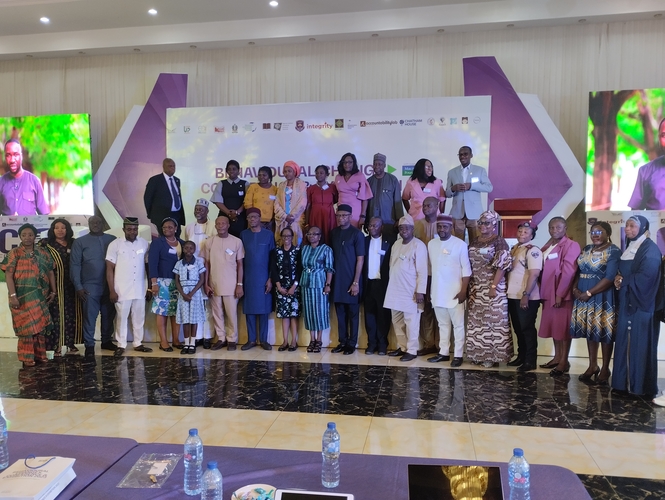
Group photo of Participants
NOTE: The section on legal Briefs is a forum for frank and open scholarly notes by research staff and guest contributors. Views expressed in these notes are personal to the authors and are not to be attributed to the Centre.
DO YOU WANT TO SHARE YOUR VIEWS ON OUR BLOG?
JURITRUST Centre for Socio Legal Research and Documentation invites submission of short articles from VOLUNTEER CONTRIBUTORS who are interested in sharing their perspectives on salient issues in the administration and development of the Nigerian Criminal Justice System, comparative systems and related issues. CLICK HERE find out how to send us your articles. Thank you