by juritrustlaw | May 24, 2024 |
Background and Context
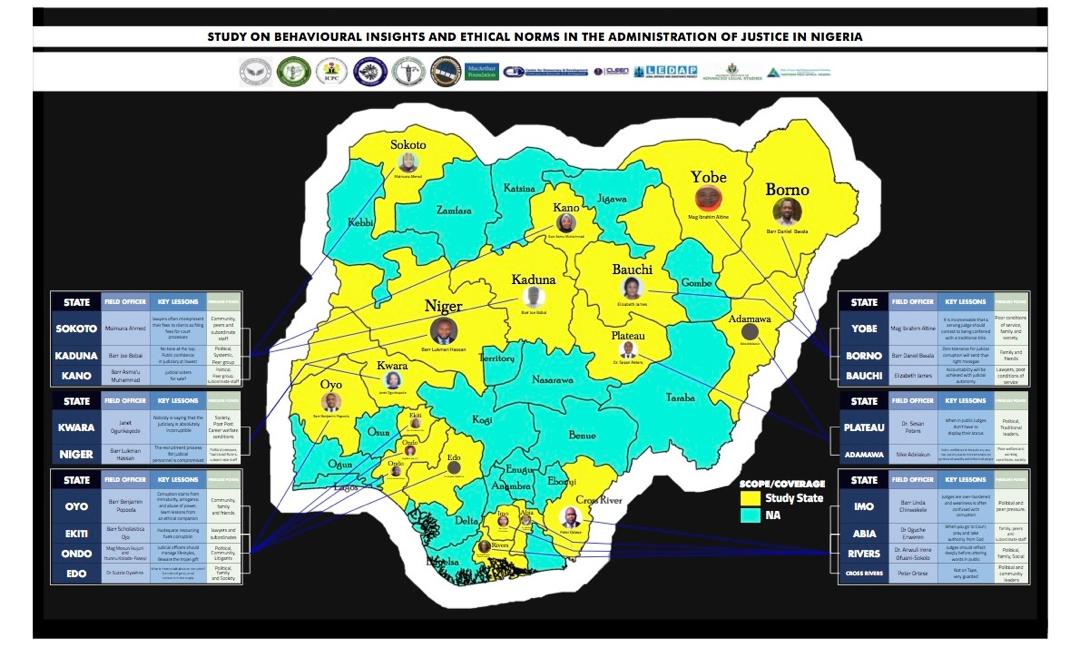
The Behavioural Insights and Ethical Norms in Justice Administration Research Study (the Study) is an interdisciplinary study of corruption in the Nigerian judicial sector. The Study is an initiative of the Juritrust Centre for Socio-Legal Research and Documentation (the Juritrust Centre). The Study is part of a larger project on the implementation of the ACJA and Anti-corruption laws by the Juritrust Centre with the support of the MacArthur Foundation. The Study duly acknowledges that the anti-corruption fight needs reform champions in critical sectors, including the Judiciary. However, it emphasizes the importance of ethics and demands behavioural change among actors and players in the judicial sector. It also acknowledges the shortcomings of technical legal training that focuses exclusively on legal frameworks and ignores the social and ethical milieu in which judicial activity exists. The Study is thus adopting behavioural change strategies and ethics to address the problem of corruption in the judicial sector. The following is an overview of the study. A detailed report of the study will be published by the Centre later this year.
The objective of the Study is to survey the perceptions, opinions and viewpoints of judicial officers and other stakeholders in the judicial sector on the scope, forms and social context of corruption in the Nigerian Judiciary. The survey was carried out through the use of semi structured interviews of judicial officers, lawyers and court users in 18 states which were spread across the six geopolitical zones of the Federation.
Duration
At the inception meeting in December 2021 after funds were received a workplan was drawn up. Several challenges including the need to secure cooperation of participating judiciaries as well as the annual vacation period for the courts slowed down the project which was initially scheduled to run from December 2021 – December 2022. As a result the Centre sought and secured a no – cost extension of the project till May 2023. The revised work plan is also attached. (Appendix A)
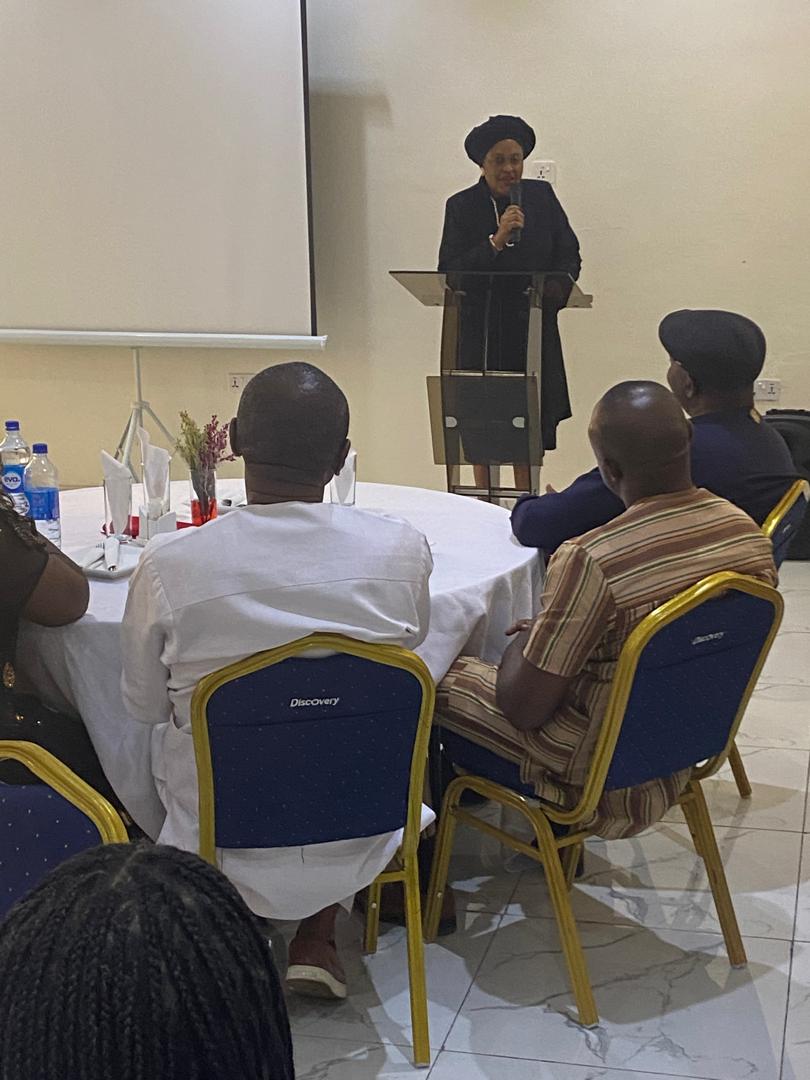
Justice Mary Odili JSC rtd addresses judicial officers at the Imo state experience sharing workshop
Selection of Respondents
Before the survey commenced, there was an assessment of the kind of participants that would be suitable for the survey. The Study required the purposive sampling of participants who could provide first-hand information on the research topic which was corruption in the Nigerian Judiciary. In selecting the category of respondents for the interviews, the research team was guided by the objectives of the research and particularly the nature of response which they sought to obtain from the participants. The respondents selected for the interview were categorized into judicial officers, lawyers and court users with judicial officers making up at least 50% of the respondents in each state.
The Juritrust Centre secured access to the judicial officers through the Chief Judge of each participating state. The judicial officers interviewed were therefore nominated by the Chief Judge and were not selected at the discretion of the Juritrust Centre or the researcher. Where a judicial
officer nominated was not available to be interviewed due to unavoidable absence or ill health, the Juritrust Centre requested for a replacement of that judicial officer by the state Judiciary. The judicial officers nominated were mainly Judges and Magistrates but in states where there was an insufficient number of Judges and Magistrates available to be interviewed, Judges of the Sharia Court and Customary Court were nominated by the state Judiciary to make up the minimum number of judicial officers required for the survey.
The lawyers and court users that were interviewed were selected by the researcher using his own initiative. This included going to the High Court and approaching lawyers and court users for interviews. The researchers were also permitted to interview their personal contacts who fit the description of a lawyer who regularly appeared in court for cases and a court user who is a party to a case in court.
Identification and Training of Researchers
Researchers for the survey were recruited through an Objective criteria which included field of qualifications and previous work experience to the job requirement. It was also a prerequisite that the researchers should be resident in the states selected for the Study. Apart from saving travel and accommodation costs they would be more familiar with the judicial sector in their respective states. The Research Orientation workshop held at Blue Springs Hotel, Abuja on the 9th and 10th of May 2022. The training workshop was intended to educate the Researchers on the Study’s objectives, to familiarize the Researchers with the research tools to be used during the interviews and to also communicate the ethical code appropriate to the survey.
Researchers engaged in role plays and other practical demonstrations in order for them to better understand how the research tools and instruments were to be utilized during the survey. The researchers were also instructed as to how to save the audio recordings and other interview documentation and how to submit them to the Juritrust Centre.
Review and Finalization of Research Tools
The research tools and instruments utilized in the Study are
-
-
- an interview guide,
- audio recorder,
- information sheet,
- consent form and
- interview
The interview guide is a semi-structured questionnaire that contained a set of questions under different themes. The semi-structured questionnaire was the main tool for conducting the interviews. In structuring the interview questions, the project team was guided by the objectives of the research and particularly the nature of response which they sought to obtain from the Study specifically on corruption in the Judiciary. The questions were structured in a manner that allowed flexibility, conversational engagement and interactions between the interviewer and respondent.
Audio recorders (and where applicable notes) were used to record the interviews. The use of audio recorders was to ensure the accuracy of responses given. Approval to use the audio recorders was obtained individually from each participant. The researchers were trained on the confidentiality of the audio recordings and this included properly storing them. The researcher also wrote interview notes to document his observations during the interview. The interview notes were important because it captured information which could not be captured by the audio recorder for example, information relating to the location of the interview, the demeanour of the respondent and the reluctance of the respondent to answer any of the interview questions. Other research tools used were the information sheet and the consent form. The information sheet contained a summary of the research with the stated objectives. The researcher was expected to read out the information sheet to the respondent at the beginning of the interview. The consent form was to be filled by the respondents and it served two purposes – to confirm that the respondents willingly participated in the research and that they also agreed for an audio recording of the interview. Where a respondent did not consent to audio recording of the interview, he indicated it in the consent form.
Edo Test/Pilot Study
The research tools were tested in a Pilot Study in Edo State. Subsequently, they were reviewed by a technical team after the data obtained from the Pilot Study was analysed. Areas of repetition were identified in the questions in the interview guide and this helped frame the interview questions used in other states. Feedback from the training workshop of Researchers which held in Abuja was also useful in finalizing the questions in the interview guide.
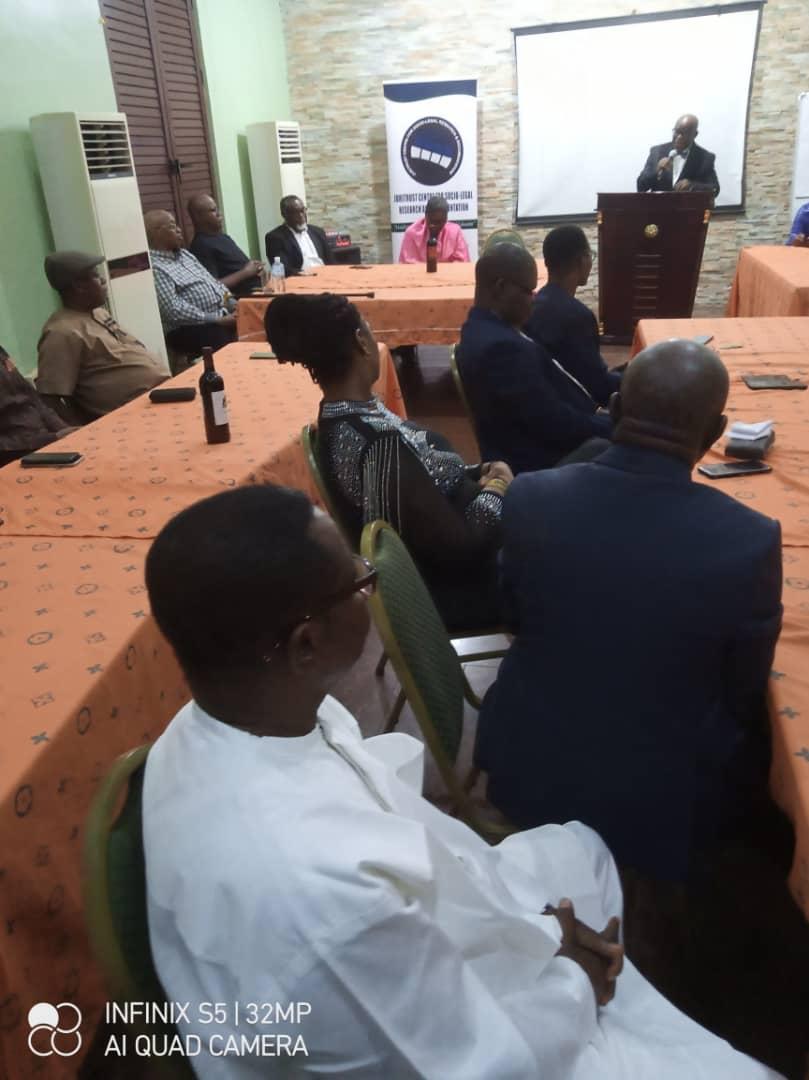
Justice W.S.N. Onnoghen charges Judicial officers at the Experience sharing workshop for Cross Rivers state judiciary
Field work and Challenges Encountered
At the end of the training workshop which held in Abuja, the researchers travelled back to their respective states. The deployment of the researchers to start the survey was dependent on the approval of the Chief Judge of the state for the interview of judicial officers in the state. Several challenges in the course of gathering data were identified by the monitoring team led by the Research coordinator.
The key challenges and how they were addressed are highlighted below.
-
-
- Challenges in obtaining the approval of the Chief Judges of several states for the interviews. There were challenges in obtaining an approval to conduct the Study in some state Judiciaries in the states initially selected. This was despite several reminders and follow up attempts by the Juritrust Centre to obtain the requisite approval. Researchers in different states also assisted in following up with the chief Registrar of the high court of the state in obtaining approval for the research Study. In spite of these efforts, some state Judiciaries did not grant approval for the Study. This led to those states being replaced by other states in the same geo-political zone.
- High turnover of Chief Judges and Chief Registrars in some states: Due to the high turnover of Chief Judges and Chief Registrars in some states, it was difficult to follow up on the initial request for approval of the Study. Where a new Chief Judge or Chief Registrar was appointed, it often led to the writing of new letters reintroducing the Study, requesting for the approval of the Study and the nomination of judicial officers for the interviews. This led to delays in the grant of approval for the Study. Delays in obtaining approval of the Study also led to delays in the conduct of the survey by the researchers because it was imperative that the approval to interview judicial officers was first obtained before the researcher could start the interview of lawyers and court users in the state.
- Refusal of some judicial officers to be recorded: In some states, some judicial officers were reluctant to permit audio recordings of their interviews. This was in spite of assurances by the researcher of the objective of the Study and the confidentiality of the recordings. For example in Cross River State, 86% of the judicial officers interviewed did not permit audio recordings of their interviews. The researcher had to take handwritten notes of the responses of those judicial officers. This method of taking notes had the potential of affecting the accuracy and completeness of the responses to the interview questions. It also lengthened the interview documentation process as the researcher had to reproduce the lengthy responses of each of the judicial officers as opposed to simply submitting the audio recording.
- Challenges with some Researchers: There were some challenges with some of the researchers who were selected to conduct the interviews. In Kaduna State, the first researcher selected was invited to Abuja for the training workshop which he attended. He was then sent a letter of engagement as a Researcher which he Afterwards, he went incommunicado as it became impossible to reach him. He did not answer phone calls and messages. He was eventually disengaged by the Juritrust Centre and replaced by another researcher in Kaduna State.
.Research Tally
A total of 530 respondents were interviewed in 18 states (including the Pilot – Edo State) Out of that number, 264 were judicial officers, 136 were lawyers and 115 were court users. A breakdown of the number of interviews conducted in each of the 17 states excluding edo state is attached as Appendix B.
Coding and Analysis of Research Data
After the conclusion of the field study phase of the research project, there was a need to transcribe, code and analyse the data from the survey . A Research Analyst was also engaged to undertake an analysis of the research data and to submit an analysis of Data. (Appendix C) In the process of quality checks
Experience Sharing (Mentoring and Feedback)Workshops
Preliminary outcomes of the survey were presented to Judges of participating states at high-level experience sharing Workshops for the Judges in the states where the field study was conducted. The participants at the workshop were the Chief Judge of the state and other Judges in the state
including the Customary Court of Appeal Judges and the Sharia Court of Appeal Judges. These Workshops are the central activity of the project and were designed to –
-
- discuss in a serene and confidential environment responses/elaborations and qualifications to the results from the field
- identify reform champions and change agents in the state and enroll them if they consent in the mentorship scheme for judicial officers
- identify peculiar and common factors that motivate or discourage unethical behavior by judicial officers
- Identify areas where the Centre can intervene further particularly in respect of capacity development, strategic planning or codes of conduct.
The design of all the Workshops was as uniform as possible. A keynote speaker – usually a retired Chief Judge of the state or an appellate Justice (serving or retired) – spoke to the sub-themes of the research and shared personal or career experiences in order to strengthen participants’ resolve and ethical values. Due to time constraints, the experience sharing Workshops unfortunately could not hold in Rivers, Adamawa, Kaduna and Borno States where the interview survey was conducted. There were scheduling challenges with the states’ Judiciary due to the conduct of the national elections, the observance of the Ramadan fast and the declaration of public holidays during the time frame specified for convening the Workshops.
Output and Further work
The output of the research project is the analyst report on the research findings. The report is attached as Appendix C. The Centre hopes to be able to use the data from this research as well as the feedbacks from the workshops to –
-
- Develop a mentorship program for judicial officers and magistrates
- Publish an edited book on Judicial ethics and Corruption
Lessons learnt
The research and interaction with judicial officers, lawyers and court users exposed the inequalities and mutual suspicion among these stakeholders. Public confidence in the Judiciary has waned; surprisingly many judges seem quite unaware of this. There is always a price to pay for being incorruptible. Some of our reform champions have often had to contend with unfavorable career decisions on account of their honesty. We were also shocked to learn that financial management and skills in many state judiciaries are poor and opaque; there seems to be no will or interest in attracting quality accounting staff.
Other lessons learnt are that –
- The issue of corruption in the Judiciary is pervasive and goes beyond judicial officers to other personnel and staff in the Judiciary as well as lawyers and litigants.
- The idea of insulating judicial officers from Society and attendant pressures has become quite impracticable with the growing number of judges and magistrates. However the risks of exposure to corruption have also multiplied. From the experience shared by participants unscrupulous litigants compromise judges using colleagues, spouses, relatives and close acquaintances.
- Judges who set an anti-corruption tone or are known for zero tolerance for corruption can be victimized through administrative measures. In one of the states a former Chief Judge known for his uncompromising stand has been denied pension for more than four years after leaving office.
- There’s need for a robust welfare package for judicial officers (including Magistrates) since they are constrained by their duties from earning income from other activities.
- The uncertainty and delays in pension entitlements of judicial officers of state High courts, is a contributory factor to the rising level of judicial corruption.
- There has to also be reasonable remuneration for staff of courts and provision of necessary equipment for them to do their jobs.

by juritrustlaw | Apr 29, 2024 |
Introduction
Once considered a dead letter law largely due to its non-enforcement, Section 21 of the Central Bank of Nigeria Act (CBN Act) 2007, which criminalizes Naira abuse, has become in recent times quite popular. The resurgence of enforcement initiatives in respect of this might not be unconnected with the controversial Naira redesign policy implemented in the wake of the 2023 general elections. This policy resulted in the purported scarcity of the Naira (especially the 500 and 1000 Naira denominations).
However, in spite of the acute shortage of the Naira notes and to the bewilderment of many citizens, several influential and famous Nigerians made a public spectacle of spraying the redesigned Naira notes at social events and parties drawing strong public criticisms and condemnations. The re-awakened interest of government agencies charged with the responsibility of both enlightening the Nigerian public, and enforcing financial-based crimes can be traced to this period. In the space of a little over one year since the Naira redesign policy, Nigerians have witnessed the suspension of a traditional ruler over alleged abuse of the Naira notes[1] and the conviction of two famous Nigerians[2] under section 21 CBN Act.
Section 21 of the CBN Act
This Section is structured as five subsections. Subsection (1) prescribes that
“[a] person who tampers with a coin or note issued by the Bank is guilty of an offence and shall on conviction be liable to imprisonment for a term not less than six months or to a fine not less than N50,000 or to both such fine or imprisonment.”
[1] Editorial, ‘Ogun Monarch Suspended for Abusing the Naira Notes’ <https://www.google.com/amp/s/punchng.com/ogun-monarch-suspended-for-abusing-naira-notes/%3famp> accessed 12th April 2024.
[1] In February 2024 an actress Oluwadarasimi Omoseyin, was jailed six months for abuse of the Naira. However she was given an option of fine. See, Deborah Sanusi, Actress jailed six months for spraying, stepping on Naira notes The Punch of 1st February 2024 https://punchng.com/actress-omoseyin-bags-six-months-jail-for-stepping-on-naira-notes The conviction of Okuneye Idris Olanrewaju (AKA Bobrisky) is reported in the media. See eg The Guardian, Naira Abuse: Bobrisky sentenced to 6 months Imprisonment without Option of Fine at https://guardian.ng/news/naira-abuse-bobrisky-sentenced-to-six-months-imprisonment-without-option-of-fine/ accessed 22/4/24
Subsection 2 states that –
“a coin or note shall be deemed to have been tampered with if the coin or note has been impaired, diminished or lightened otherwise than by fair wear and tear or has been defaced by stumping, engraving, mutilating, piercing, stapling, writing, tearing, soiling, squeezing or any other form of deliberate and wilful abuse whether the coin or note has or has not been diminished or lightened.”
“For the avoidance of doubt, spraying of, dancing or matching (sic) on the Naira or any note issued by the Bank during social occasions or otherwise howsoever shall” according to subsection 3, “constitute an abuse and defacing of the Naira or such note and shall be punishable under Sub-section (1) of this section.” The penultimate subsection[3] provides that “[i]t shall also be an offence punishable under Sub-section (1) of this section for any person to hawk, sell or otherwise trade in the Naira notes, coins or any other note issued by the Bank”.
The final subsection[4] defines the words matching and spraying. The former includes “spreading, scattering or littering of any surface with Naira notes or coins and stepping thereon, regardless of the value, volume, occasion or intent”, while the latter includes “adorning, decorating or spraying anything or any person or any part of any person or the person of another with Naira notes or coins or sprinkling or sticking of the Naira notes or coins in a similar manner regardless of the amount, occasion or the intent.”
Recent Convictions Under Section 21 of the CBN Act
The two recent convictions for the abuse of the Naira involved a Nollywood actress, Oluwadarasimi Omoseyin, and a popular cross-dresser Bobrisky.
Oluwadarasimi Omoseyin’s Case
The case of the prosecution was partly: “[t]hat you, Oluwadarasimi Omoseyin, on the 28th day of January, 2023, at Monarch Event Centre, Lekki, Lagos, within the jurisdiction of this Honourable Court, whilst dancing during a social occasion tampered with the sum of N100,000.00 (One Hundred Thousand Naira) issued by the Central Bank of Nigeria by spraying same in the said occasion and you thereby committed an offence contrary to and punishable under Section 21(1) of the Central Bank Act, 2007.”
[1] Section 21(4) CBN Act 2007
[1] Section 21(5) CBN Act 2007
She initially pleaded ‘not guilty’ to the charges preferred against her and was subsequently granted bail. But at a resumed hearing, she changed the plea to ‘guilty’ and was convicted accordingly. Premium Times reports that:
The defence counsel, Afuye Adegbola, pleaded for leniency saying, “she’s a first-time offender; she is a mother of one; she is remorseful and pleads for mercy.” He further pleaded for a non-custodial sentence on behalf of the convict. Delivering judgement, Mr Aneke sentenced the defendant to six months’ imprisonment, with an option of N300,000 fine to be paid into the consolidated revenue account of the federation[5].
Okuneye Idris Olanrewaju (Bobrisky)
One of the charges brought against Olanrewaju include: “[t]hat you, Okuneye Idris Olanrewaju, on the 24th day of March, 2024, at Imax Circle Mall, Jakande, Lekki, within the jurisdiction of this Honourable Court whilst dancing during a social event tampered with the total sum of N400,000.00 (Four Hundred Thousand Naira) notes issued by the Central Bank of Nigeria by spraying same and you thereby committed an offence contrary to and punishable under section 21(1) of the Central Bank Act, 2007.”
Unlike Omoseyin, Olanrewaju pleaded guilty from the onset and in his allocutus, the informed the court that he was ignorant of the law and if released, he would use his social media platform with over 5 million followers to educate Nigerians on the law against Naira abuse.
He was however sentenced to six months imprisonment without an option of fine. Justice Abimbola Awogboro, while sentencing the convict, said the judgment would be a deterrent to others who are found abusing and mutilating the Naira[6].
General Comparison of Both Cases
| Area of Comparison |
Omoseyin’s Case |
Olanrewaju’s Case |
| Gender of convict |
Female |
Male |
| Plea entered upon arraignment |
Initially, ‘not guilty.’ Subsequently changed to ‘guilty.’ |
‘Guilty’. |
[1] Premium Times ‘Court Convicts Actress of Spraying, Stepping on Naira Notes at Wedding Party’ <https://www.premiumtimesng.com/news/top-news/664514-court-convicts-actress-of-spraying-stepping-on-naira-notes-at-wedding-party.html?tztc=1> accessed 12th April 2024.
[1] Editorial, ‘Court Sentences Bobrisky to Six Months in Prison’ <https://www.google.com/amp/s/punchng.com/breaking-court-sentences-bobrisky-to-six-months-in-prison/%3famp> accessed 12th April 2023.
| Sentence |
Six months imprisonment with an option of N300,000.00 fine |
Six months imprisonment without an option of fine |
| Name of Judge |
Chukwujekwu Aneke J. |
Abimbola Awogboro J. |
| Gender of Judge |
Male |
Female |
| Marital Status (and children) |
Married with a child |
Single and no child. |
| Year of Birth |
1995 |
1991 |
| Date of Conviction |
2nd February 2024 |
12th April 2024 |
Conclusion
There are opinions in certain circles that the punishment meted on Olanrewaju was quite harsh. But given the media coverage the Omoseyin case garnered, it would have been expected that all Nigerians, particularly social media influencers and personalities, turn a new leaf. Perhaps, the option of fine given by the judge in Omoseyin’s case created a soft-landing which did not deter future offenders. It should also be noted that the six months imprisonment is the minimum penalty permissible under the Act and therefore section 416(2)(d) of the ACJA which cautioned against the imposition of maximum punishment for a first offender was inapplicable to the case.
NOTE: The section on legal Briefs is a forum for frank and open scholarly notes by research staff and guest contributors. Views expressed in these notes are personal to the authors and are not to be attributed to the Centre.
DO YOU WANT TO SHARE YOUR VIEWS ON OUR BLOG?
JURITRUST Centre for Socio Legal Research and Documentation invites submission of short articles from VOLUNTEER CONTRIBUTORS who are interested in sharing their perspectives on salient issues in the administration and development of the Nigerian Criminal Justice System, comparative systems and related issues. CLICK HERE find out how to send us your articles. Thank you

by juritrustlaw | Apr 26, 2024 |
Invariably by the time the cases/appeal processes come to an end, Police officers and members of the public would have forgotten the incidents.
The point l want to make, my Lords, is that when Police officers are prosecuted or convicted for killing innocent members of the public, such incidents are not adequately publicised. I believe that this lack of knowledge of how the legal process works is responsible for the belief of some Police officers that they can get away with killing members of the public, since they don’t see the immediate consequences of their actions.
The erroneous belief of Police officers about their immunity from prosecution and the sense of impunity has once again been shattered by the High Court of Lagos State in Bolanle Raheem’s case. The point l want to make, my Lords, is that when Police officers are prosecuted or convicted for killing innocent members of the public, such incidents are not adequately publicised. I believe that this lack of knowledge of how the legal process works is responsible for the belief of some Police officers that they can get away with killing members of the public, since they don’t see the immediate consequences of their actions. All they see is that their colleagues involved in such incidents are given Orderly Room Trials, if they are junior officers, and are dismissed by the Police. They don’t know that the legal process of prosecution and appeals inexorably continues to the highest court, especially where the defendants had been charged and sentenced to death at the trial court.
Invariably by the time the cases/appeal processes come to an end, Police officers and members of the public would have forgotten the incidents. It’s only those who lost their loved ones who remember where they’ve kept track of the case. It is also important to make the point that it is not because of the public outcry over Bolanle Raheem’s case that ensured the prosecution of the Police officer, but that the law had always taken its course in most cases of such incidents. The following are a few decisions l can remember off the cuff in the last couple of years, where the Supreme Court had affirmed the conviction of Police officers who killed members of the public. There are many more of these decisions and many at different stages of trial and appeal. My point is that Policemen, at large, need to be enlightened about the consequences of their actions. Let us educate those within our sphere of influence. Hopefully, this will minimise similar incidents.
- In P.C Henry Ekum v. The State – Appeal No. SC.1103/2017, reported in (2022) LPELR-57683(SC), delivered on 13th May, 2022, the following happened: On 23 October, 2010, at Number 24 Ochedore Street, Four Corners, Ikom in Calabar, Cross River State, the appellant (a Police officer) murdered one Ebam Takim Obiba by shooting him on the head with an AK47 rifle. The appellant had held a certain woman hostage in a salon and after an altercation with his colleague on one side and the woman’s husband and the deceased on the other side, he started shooting randomly and killed the deceased. He was convicted of murder and sentenced to death by hanging. His death sentence was affirmed by the Supreme Court.
Onyebucho Onwunze v. The State – Appeal No. SC.215/2017, delivered on 2nd December, 2022. On 25th of March, 2007, in Ilupa Village at Godwin Ozuma’s compound, the appellant (a Police officer) took a combatant position on being commanded by his superior officer, and shot and killed one Anna Otari Ogbodo, an unarmed elderly woman. The court convicted the appellant of murder and sentenced him to death by hanging. The death sentence was affirmed by the Supreme Court.
- Matthew Egheghe v. The State – Appeal No. SC.304/2017- Reported in (2020) LPELR- 50552 (SC), delivered on 10th January, 2020, the following happened: On Sunday 16th October, 2011, along Sani Abacha Express Way, Yenagoa, one Emmanuel Victor was on his way from church when he encountered some Policemen. The appellant (a Police Officer) chased down the motorcycle wherein Victor was a passenger after having slapped him previously, pulled him down and shot him several times to death. The appellant was convicted of murder and sentenced to death by hanging. His death sentence was affirmed by the Supreme Court.
- Akinyede Olaiya v. The State – Appeal No. SC.562/2014 reported in 2017) LPELR-43714delivered on 8th December, 2017, the following happened: On 23rd March, 2011, at Ota Junction, Omuo Ekiti in Ekiti State, the appellant (a Police officer) fired two shots into the crowd without provocation or any real threat to his life or the lives of other policemen with him. The shots fired by the appellant killed one Kehinde Ayo Faluyi who was in that crowd. The appellant was convicted and sentenced to death. His death sentence was affirmed by the Supreme Court.
- P.C Adeusi Adesina v. The People of Lagos State – Appeal No. SC. 622/2014, Reported in (2019) LPELR – 46403 SC), delivered on 18th January, 2019, the following happened: On 27th November, 2008, the appellant, a Police constable, in Apogbon Blackspot, Lagos State, shot a lorry driver named Dauda Isiako Akao and killed him. He was convicted of manslaughter and sentenced to 14 years imprisonment. His sentence was affirmed by the Supreme Court.
- The State v. P.C. James Egigia (SC)(unreported) delivered on the 26th day of January, 2024. The respondent, who is a policeman, on or about the 16th day of February, 2006, at Ayama village in Auyo Local Government Area of Jigawa State, seriously beat and fractured the leg of the deceased, one Ismaila Dodo, while investigating a case. The injuries led to the death of the deceased. The trial court found the respondent guilty of the offence of committing serious assault under Section 224 and punishable under Section 225 of the Penal Code Law and sentenced him to five years imprisonment without the option of fine. The sentence was affirmed by the Supreme Court.
Helen Moronkeji Ogunwumiju is a justice of the Supreme Court of Nigeria.
This is the text of a paper shared with the National Association of Women Judges.
CREDIT. Premiumtimes
NOTE: The section on legal Briefs is a forum for frank and open scholarly notes by research staff and guest contributors. Views expressed in these notes are personal to the authors and are not to be attributed to the Centre.
DO YOU WANT TO SHARE YOUR VIEWS ON OUR BLOG?
JURITRUST Centre for Socio Legal Research and Documentation invites submission of short articles from VOLUNTEER CONTRIBUTORS who are interested in sharing their perspectives on salient issues in the administration and development of the Nigerian Criminal Justice System, comparative systems and related issues. CLICK HERE find out how to send us your articles. Thank you