
Corruption no doubt has taken a toll on Nigeria. This menace has led to several efforts by stakeholders in advocating accountability and transparency to curb corruption. The innovative ingenuity brought to fore Behavioral Change. Behavioral Change can be defined as the process of modifying an individual’s actions, attitudes and habits to improve productivity, performance and overall wellbeing. In this case, it means remodeling people’s acceptance of corruption and persuading them to reflect good values in society. To encourage more behavioral change approaches in Nigeria, the Behavioral Cohort Group of the MacArthur Foundation organized a Conference titled: Behavioral Change Conference and Exhibition 2023. The theme of the Conference was ‘Fostering a Corrupt Free Nigeria”.
Why Behavioral Change?
Speaking on the importance of Behavioural Change, the Director of MacArthur Foundation Dr. Kole Shettima, gave a brief background story on how the approach was incorporated. He mentioned that having seen the limited impact of the conventional technique of law and order, through series of research and discussions with stakeholders the Foundation garnered ideas and fronted Behavioural Change Approach. The Behavioral Change Cohort comprise four groups namely: Capacity Building and Direct Community Engagement Group, Mainstream Media Group, Policy & Strategy Development Group and Faith Based Intervention Group. Through media, religious teachings, advocacy, technology and gender equality and social inclusion and other innovative processes, the Cohort set out to achieve their goals. These are mainly to reform value systems, norms, attitudes and beliefs that ensure Nigerians become corrupt-free.
Speakers addressed the importance of having an enabling environment where everyone participates and no one is secluded for whatsoever reason. Mr Toyin Akinniyi Vice President of Africa Luminate emphasised the importance of gender equality and social inclusion which leaves no one behind. Speaking from the sector of persons with disability who are usually neglected, Uche Andrew representative of Joint National Association for Persons with Disabilities (JONAPWD) condemned the poor treatment given to such persons and the weakness of the law protecting them. This exposes them to corruption as they are more often than not treated less than others in the society due to their disabilities. On the importance of including religious bodies in Behavioral Change activities, Dr. Otive Igbuzor, Executive Director, Centre LSD mentioned the strength of the religious bodies over secular powers. He anchored his position on the fact that many Nigerians are very religious hence they are more obedient to their respective religious leaders and dictates than to any other authority. He spoke on how the benefits of using teachings, art and direct advocacy by religious leaders to spread the gospel of anti-corruption to the believers. They also addressed gender equality by ensuring interpretation of religious books are not done from patriarchical lens.
The outgoing Chairman of ICPC, Prof. Bolaji Owasanoye, SAN gave an interesting insight on how social pressure from friends and family is one of the strongest factors causing corruption in government institutions. He called for the enactment and implementation of Whistle Blowers Act and Witness Protection Act which would secure more accountability and transparency amongst public officers.
Ms Catherine, a representative of UNODC spoke on sustainable behavioural patterns that could combat corruption although disclosing that that bribery is an enabler for corruption in Nigeria. She recommended concerted efforts through multi-stakeholder collaboration and reflection on the UN Convention on Corruption.
Highlights on shared views by behavioural change cohort members
On the issue of change of approach with behavioural change for key heads of government institutions and MDAs, Nigerian Institute for Social and Economic Research opined that they would take up the areas of interests from the leaders during training and follow through while the Anti-Corruption Academy of Nigeria (the ICPC Academy) proposed timely intervention upon appointment of new key leaders.
The organizations shared revealing insights. For example,the Policy Innovation Centre cited pressure from friends and family as strong factors that causes corruption. Nigerian Institute for Social and Economic Research on the other hand from their research identified abuse of office and powers as the strongest enabler of corruption in government institutions.
In terms of efficient strategies, most of the organizations under the Mainstream Media Group shared perspectives and experience. For example, Equal Access International stated that direct community engagement with people and community leaders enabled their interventions, Moving Images and Arewa 24 commended to advocates the use of drama and research while Griot Studios made great progress with social media. The importance of data storage was also addressed by Griot Studios as this helps in terms of evaluation and monitoring of projects. Use of pre and post evaluation forms are key in any intervention. Equal Access corroborated Griot Studios by stating how experience and evaluation surveys have strengthened impact over the past months. Alhabibiyyah uses advocacy through religious leaders by infusing anti-corruption in religious messages and teachings. Lux Terra Foundation made great impact through participatory workshops in schools and amongst youths in religious centres.
How do the organisations keep their engagement level with the audience? The organisations reported that over time the audience levels have increased. Arewa24 mentioned the importance of good storylines. It employs realistic scenarios in passing out information through drama series and conducts research on what is more appealable to their target audience.
For the Palace of Priests Assembly a memorable development was the large turnout of pastors that participated this year for the first time on 11th July, 2023 in a Walk Campaign against Corruption. Usually, they are conservative about political issues, but through advocacy, they turned up.
In the panel session titled “The Role of Civic Education and Citizen Engagement in Advancing Anti-Corruption, Accountability and Good Governance in Nigeria” one of the critical issues centred on children’s participation in the anticorruption campaign. Step up Nigeria discussed how they were able to teach children the importance of accountability and transparency through seminars and books. This is in order to catch them young as the famous saying goes “a stitch in time, saves nine”. Another issue focused on sanctions. Despite the formal sanctions in place, the rate of corruption is still high, the panelists particularly StepUp Nigeria maintained that social sanctions are less effective than formal sanctions. Social sanction is merely persuasive. However, it depends on the concerned individual to retrospect and remodel bad ways. In terms of measuring success, Akin Fadeyi Foundation stated that the number of persons that were converted and leaned towards anticorruption principles encouraged the Foundation in terms of continuing their interventions.
The discussion then examined the issue of dealing with corruption in the judiciary, workplace and schools. The meeting wonder where the common man runs to for justice since that judiciary has been compromised. Integrity Nigeria suggested having strict scrutiny of judges at the point of appointment and periodic trainings. However, the name-shame mechanism is useful to deter others. In a case where an organisation has been captured by corrupt key heads, it was suggested that whistleblowing becomes necessary. For the corruption in schools, a narrative was rendered of how kids lobby and bribe to be elected prefect by “gifting” books, pens and snacks to win the minds of others. If this is allowed at this age, what more when they grow and seek political seats? Step Up Nigeria blamed parents as the cause of unhealthy competition in children. If the children are taught good values, such would not come to mind but it is the parents that support them with the bribery materials so they can win over others. More so, StepUp suggested the Ministry of Education to set up rules in schools addressing corruption such as discouraging unfair competition. Also, incorporation of anti-corruption in school curriculums will enhance advocacy.
In terms of charting a way forward towards designing a collective agenda for behavioural change and anti-corruption, the following suggestions were agreed upon by stakeholders:
- Incorporation of anti-corruption in school curriculum
- Quick interventions upon appointment of new heads of government organisations and MDAs
- Use of Predictive, Preventive and Corrective mechanisms
- Use of communication and reporting mechanisms
- Train media on anti-corruption report
- Promote accountability and collective action
- Encourage citizenry reporting
- Measure Impacts periodically
- Use of Sustainable and practical interventions
- Youth and GESI mainstreaming for inclusive participation
The conference was impactful as it gave participants an opportunity to look at behavioural change and anti-corruption through insights and interventions shared by the Cohort. It behoves on everyone to do the right thing at all times. “Corruption is criminal, immoral and the ultimate betrayal of public trust” – Antonio Guterres, UN Secretary General.
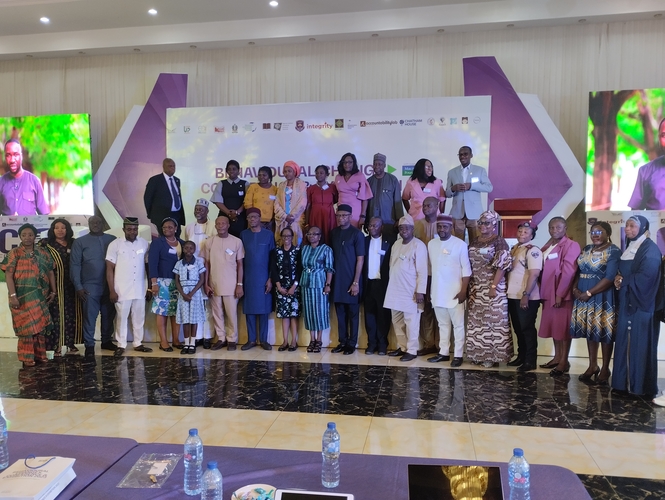
Group photo of Participants
NOTE: The section on legal Briefs is a forum for frank and open scholarly notes by research staff and guest contributors. Views expressed in these notes are personal to the authors and are not to be attributed to the Centre.
DO YOU WANT TO SHARE YOUR VIEWS ON OUR BLOG?
JURITRUST Centre for Socio Legal Research and Documentation invites submission of short articles from VOLUNTEER CONTRIBUTORS who are interested in sharing their perspectives on salient issues in the administration and development of the Nigerian Criminal Justice System, comparative systems and related issues. CLICK HERE find out how to send us your articles. Thank you